CLIENT LOGIN
 PAY MY BILL


A revenue cycle team can work every account on its daily list and still fall short of its collection goals. Sometimes the problem is not how hard the team is working. It is whether the right accounts are reaching the right people at the right time.
That is a familiar challenge for patient accounting and revenue cycle leaders. An aging report identifies what is outstanding. A work queue assigns responsibility. A monthly dashboard shows what happened. But those tools do not necessarily answer the question a supervisor faces each morning: Where will our effort make the greatest difference today?
Predictive analytics in revenue cycle management can help answer that question. The opportunity is not simply to produce another score or dashboard. It is to turn historical experience into better operational decisions.
Key Takeaways
- Look beyond age and balance. Predictive analytics in revenue cycle management uses patterns across payer, account type and payment history to show where effort will matter most.
- Likely to pay is not the same as needs a call today. The better question is what action is appropriate, and where the team can add value.
- Start small. One population, one operational question and a defined pilot, measured in outcomes that matter.
Beyond Aging Reports
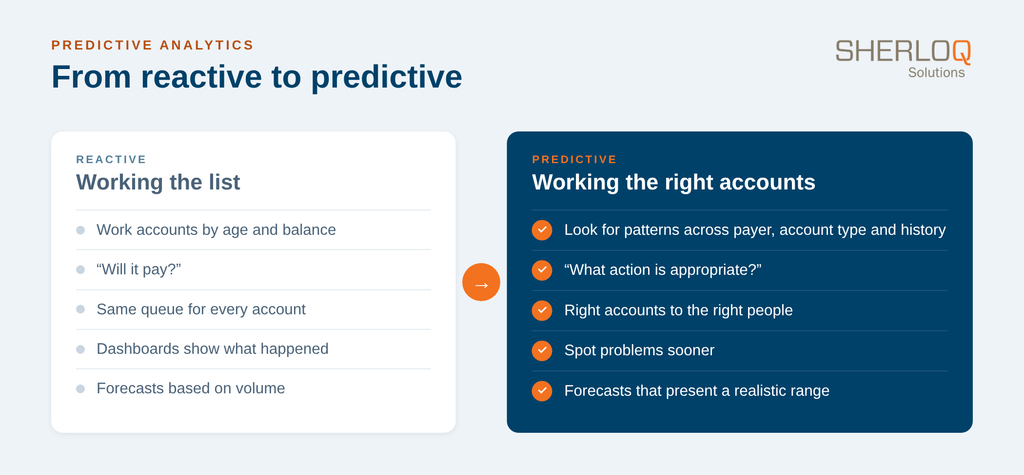
Balance and age are useful starting points for prioritizing inventory, but they do not tell the whole story.
Consider two insurance accounts with similar balances and discharge dates. One may be moving through normal payer processing and likely to pay without additional follow-up. The other may be stalled because of a coding issue that requires a specific correction. Placing both in the same follow-up queue can create unnecessary work on the first account and delay resolution on the second.
A predictive approach looks for patterns across information such as payer, account type, balance, placement timing, prior payments, and available denial information. Those patterns can help teams distinguish between accounts that warrant immediate attention, accounts that need specialized review, and accounts that may be better monitored.
The goal is a more informed worklist, not a longer one.
Payment Likelihood Is Only the Beginning
Propensity-to-pay models estimate how likely an account is to produce a payment within a defined period. Used thoughtfully, those estimates can help supervisors prioritize inventory and focus limited resources.
But there is an important distinction: an account that is likely to pay is not necessarily an account that needs a call today.
A high-scoring account may already be on its way to payment. Another account may have a lower estimated likelihood of payment but a clear, actionable barrier that an experienced representative can resolve.
For Sherloq Solutions, this is an important direction for analytics: looking beyond “Will it pay?” toward “What action is appropriate, and where can our team add value?”
That requires more than payment history. It also requires understanding when accounts were worked, what action was taken, and what happened afterward. Even a payment received after a call does not, by itself, prove that the call caused the payment.
Finding Problems Earlier
The value of predictive analytics in healthcare billing extends beyond individual accounts.
Suppose a hospital sees more balances from a particular payer moving past 60 days. Are claims taking longer to process? Are denials increasing? Or are corrected claims waiting for follow-up? Understanding what is driving the change helps the revenue cycle team decide where to focus.
Similarly, a growing concentration of unpaid accounts within one service area may point to an authorization or coding issue. Reviewing those patterns can help teams identify a shared problem instead of repeating the same research account by account.
AI in revenue cycle management also creates opportunities to make better use of account notes. A carefully tested tool could identify language suggesting a coding review and recommend the appropriate queue.
Better Forecasts, Clearer Expectations
Predictive information can also support more realistic collection forecasts.
Account volume alone is not enough. A smaller inventory with higher balances does not automatically represent more collectible revenue. Payer mix, inventory age, payment timing, and unresolved barriers all matter.
A useful forecast combines those factors with historical collection behavior and presents a reasonable range. A propensity-to-pay score estimates payment likelihood; it does not mean that the same percentage of an account’s balance will be collected.
That distinction matters when leadership uses a forecast to plan staffing, set expectations, or evaluate performance.
Start With the Work
Organizations do not need to transform their entire revenue cycle at once. A practical starting point is one population, one operational question, and a defined pilot.
Success should be measured in outcomes that matter: collections, resolution time, staff effort, and patient experience. Testing should also examine whether improvements hold up on new accounts, not just the historical records used to build the model.
Reliable data, appropriate privacy controls, and operational expertise are essential. A model cannot explain a payer process as well as someone who works with it every day unless that knowledge is reflected in how the tool is built, tested, and used.
At Sherloq Solutions, we are developing analytics around those everyday decisions, with operational leaders helping shape and evaluate the work. The purpose is to give experienced teams better information, not replace their judgment.
The future of revenue cycle management is not a dashboard that predicts everything. It is a team that can spot problems sooner, choose its next action more deliberately, and spend more time on work that moves accounts toward resolution.
Ready to focus your team on the right accounts?
Backed by more than 100 years of industry experience, Sherloq partners with healthcare providers across the revenue cycle.
Let’s Connect →