CLIENT LOGIN
 PAY MY BILL

Every health system is working to protect its margins without losing sight of the patients it serves. When it comes to patient balances, those two goals can feel like they pull in opposite directions.
Much of the attention goes to the back end of the revenue cycle, from denial management to aged accounts and bad debt. But some of the most important moments happen much earlier, in the first weeks after a balance becomes the patient’s responsibility. That’s when patients form their impression of how your organization handles billing, and when balances are easiest to resolve. It’s also the window early-out billing is built for.
In our experience, most self-pay money comes in during those first 30 days. Here’s how to make them count.
Key Takeaways
- The clock starts when the balance is final. Outreach should begin as soon as the balance is confirmed as the patient’s responsibility.
- The first contact matters most. Aim to resolve the account in that first conversation.
- Make it easy to say yes. Clear explanations and simple ways to pay help balances resolve before they reach bad debt.
What Is Early-Out Billing?
Early-out billing, often run as an early-out self-pay program, is outreach on patient balances that begins soon after they become the patient’s responsibility, before an account becomes delinquent or moves to bad debt.
Its job is to help patients understand and resolve what they owe while the visit is still recent.
Why the First 30 Days Matter in Early-Out Self-Pay
Early on, the patient has just received care and the bill is recent. The balance is easy to connect to the visit, and the patient is still easy to reach.
After the first 30 days, patients become harder to reach. Contact information goes stale, statements go unopened and calls go unanswered. Accounts that could have been resolved with one clear conversation are more likely to age into bad debt.
A Closer Look at the First 30 Days
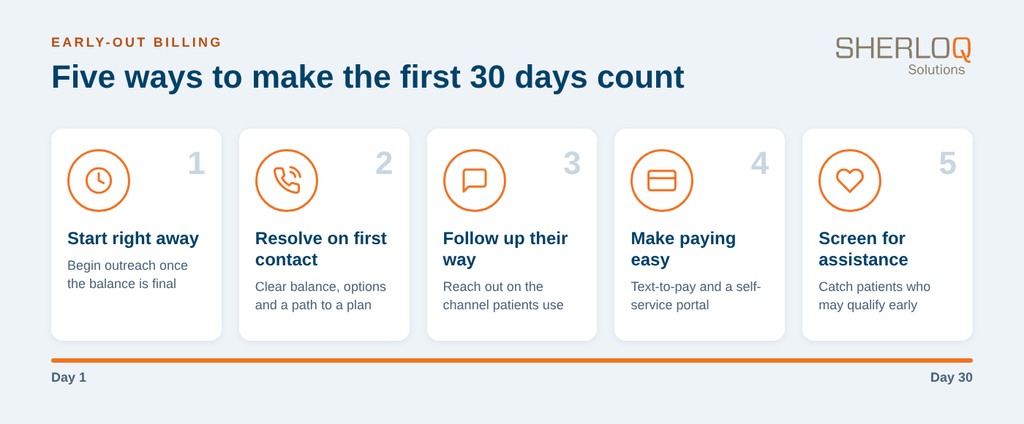
1. Start right away.
Begin outreach as soon as the balance is confirmed as the patient’s responsibility. The amount is accurate, and the patient hears from you while the visit is fresh.
2. Resolve on the first contact.
Every extra contact adds time and frustration for the patient. When someone answers, the conversation should include accurate balance information, clear payment options and a path to a payment plan or financial assistance review.
At Sherloq, we strive to resolve the account on the very first contact.
3. Follow up the way patients prefer.
If the first attempt doesn’t connect, reach out again through the channel each patient is most likely to use, with clear and respectful messages.
4. Make paying easy.
Text-to-pay lets patients resolve a balance in a few taps. A self-service payment portal lets them pay or set up a flexible payment plan without waiting on hold.
5. Screen for financial assistance early.
Identify patients who may qualify early, in line with your organization’s policy, so no one is pushed toward collections by mistake.
What Makes the Experience Work
Early-out is often the first billing conversation a patient has after care. How it feels shapes how they see your organization.
- Plain language. Explain what insurance covered, what the patient owes and when it’s due, without billing jargon.
- Trained, coached representatives. Ongoing training and real-time coaching help every conversation stay clear and empathetic.
- Speech analytics. Reviewing calls helps teams see what’s working and focus coaching where it’s needed.
- Listening to patients. Patient surveys show how the experience feels from the patient’s side. Sherloq has a 97%+ patient satisfaction rating.
Frequently Asked Questions (FAQ)
How is early-out billing different from bad debt recovery?
Early-out works balances while they are new, with a focus on clear communication and easy payment. Bad debt recovery works balances that have aged past that stage.
Why do the first 30 days matter so much?
In our experience, most self-pay money comes in during that window. After it, patients become harder to reach.
What does first-contact resolution mean?
It means resolving the account in the first conversation with the patient, whether through payment, a payment plan or a financial assistance review.
Make the First 30 Days of Your Early-Out Self-Pay Program Count
The first 30 days set the course for most self-pay balances. Start right away, make the first conversation count and make paying simple.
Do that well, and more balances resolve early, fewer reach bad debt and patients leave with a better impression of your organization.
Backed by more than 100 years of industry experience, Sherloq partners with healthcare providers across the revenue cycle, including insurance, pre-service resolution, early-out self-pay and bad debt recovery.