CLIENT LOGIN
 PAY MY BILL

Search “healthcare collections solutions” and the results start to look alike: proprietary technology, compliant processes, patient-friendly outreach, seamless integration.
However, the differences that matter rarely show up on the landing page. Instead, they tend to surface months into a contract.
So how do you see them before you sign?
Key Takeaways
- Look past the feature list. Ask how the vendor works accounts from placement to resolution.
- Test compliance claims. Ask how the vendor builds compliance into its day-to-day workflow.
- Define “patient-friendly.” Ask how the vendor hears from patients and handles possible financial assistance cases.
Why Healthcare Collections Is Its Own Discipline
Generic debt collection and healthcare collections both involve recovering unpaid balances. That’s where the similarity ends.
- The person on the call may still be your patient. As a result, common consumer-collection tactics can damage a relationship your health system needs to keep.
- Regulatory exposure is layered. The FDCPA governs third-party collectors, nonprofit hospitals carry 501(r) obligations, and many states also have their own medical debt rules.
- Insurance complexity sits under every balance. A partner that doesn’t understand how a claim reached patient responsibility will misjudge which accounts it can collect.
What to Evaluate in Healthcare Collections Solutions
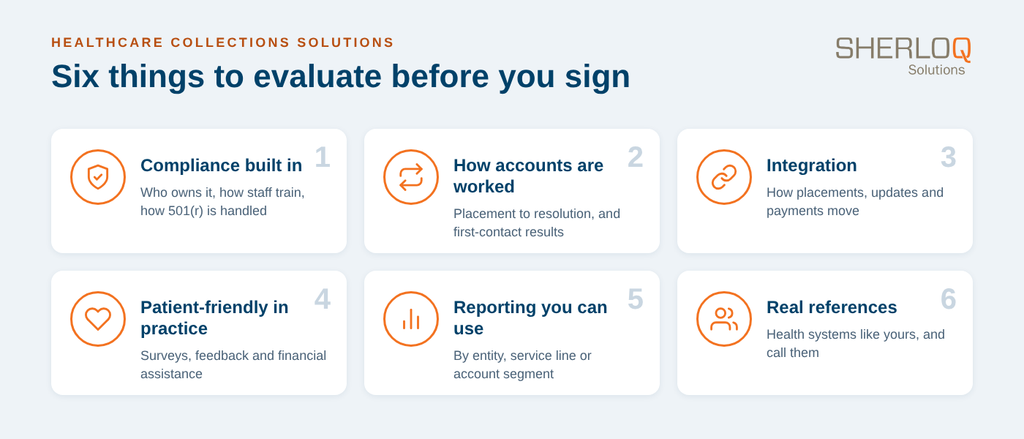
1. Compliance infrastructure, not just a compliance claim.
Ask who owns compliance, how the vendor trains its staff, and how its process accounts for federal, state and 501(r) requirements.
Also ask how the vendor protects patient information, and whether its processes are HIPAA-compliant.
2. How the vendor works accounts, not just the technology it uses.
Ask for the workflow from placement to resolution. For example, how quickly does outreach begin?
What happens the moment a patient pays? Does all outreach stop right away?
Next, ask how often the vendor resolves accounts on the first contact. At Sherloq, we strive to resolve the account on the very first contact.
3. Integration with your existing systems.
Ask how placements, updates and payments move between your systems and the vendor’s.
In addition, ask how long setup takes, and whether the vendor can work with the systems you already have.
4. What “patient-friendly” means in practice.
Ask how the vendor hears from patients, such as through patient surveys, and what it does with that feedback.
Then ask how it handles patients who may qualify for financial assistance but that no one has flagged yet.
At Sherloq, we hold a 97%+ patient satisfaction rating.
5. Reporting you can use.
Ask whether the vendor can break out reporting by entity, service line or account segment, and