CLIENT LOGIN
 PAY MY BILL

The Debt Collector Paradox
The term “debt collector” is a reputational liability. For most businesses, the industry is synonymous with aggressive tactics and brand-damaging customer interactions. This makes the case of Sherloq Solutions, a a 109-year-old healthcare collections agency, a critical business paradox. The firm doesn’t just recover outstanding medical balances; it does so while maintaining a 97% positive patient satisfaction rating.
This seemingly impossible statistic presents a crucial case study in managing operational excellence and reputational risk in a traditionally low-trust industry. How does an agency whose function is inherently adversarial achieve near-perfect satisfaction scores? This analysis breaks down the four core strategies that transform a difficult financial conversation into a technology-enabled, compliance-driven service model.
1. They Focus on Preventing Debt Before It Starts
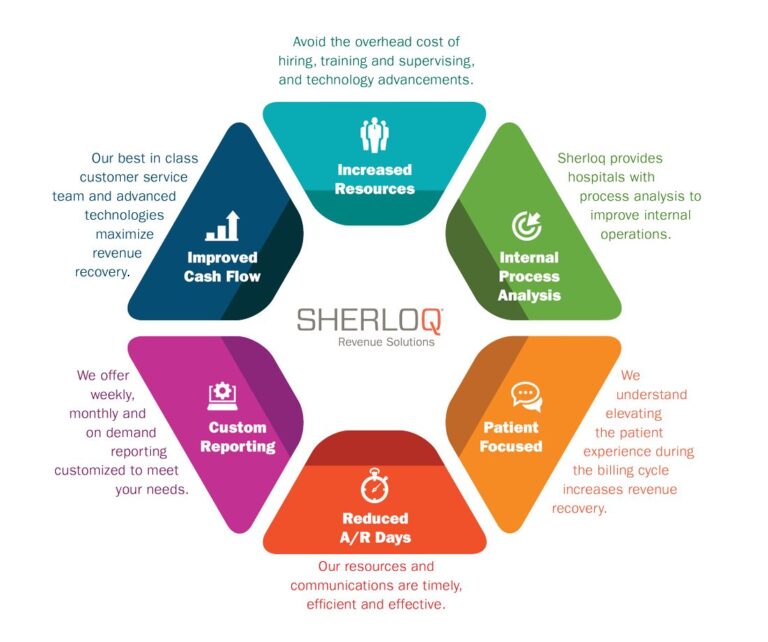
A key competitive advantage for Sherloq Solutions is its focus on intervening before an account becomes a collection problem. Their strategy is twofold: they manage patient-side financial expectations while simultaneously helping healthcare providers optimize their own revenue cycles and reduce billing errors.
A suite of services beyond traditional collections drives this proactive model:
- Patient-Facing Services: Services like Pre-Service Collection (PSC) communicate estimated costs and collect co-pays upfront, preventing surprise bills. Early Out Self-Pay (EBO) acts as an extension of the hospital’s business office to resolve balances before they default, maintaining a positive patient-provider relationship.
- Provider-Facing Services: The agency performs insurance follow-up and denial and appeals management, recovering funds directly from payers. It also provides trend analysis reporting, a diagnostic tool that helps providers identify and fix systemic billing issues at the source.
This comprehensive approach redefines the agency’s role from a simple debt collector to a strategic healthcare collections partner, working to minimize bad debt for both the patient and the provider.
2. Technology Isn’t Just for Efficiency – It’s for Enforcing the Rules
While many firms use technology for simple efficiency gains, Sherloq Solutions deploys its tech stack as a sophisticated compliance and risk management engine for healthcare collections. In the highly regulated landscape of medical debt, this transforms compliance from a costly manual liability into an automated, auditable asset.
The technology enforces strict adherence to the Health Insurance Portability and Accountability Act (HIPAA) and the Fair Debt Collection Practices Act (FDCPA). Here’s how it functions as a compliance officer:
- The multi-platform dialer and direct drop voicemail systems are programmed to automatically follow legal limits on call frequency.
- The system creates a timestamped audit trail by logging every call, text, and email.
- Automation removes the risk of human error in high-volume, repetitive compliance tasks that are governed by complex rules.
From an operational standpoint, this reframes automation. It is not merely a cost-cutter but a core component of a de-risked business model built on a foundation of legal and ethical conduct.
3. Humans Are Reserved for Conversations That Require Nuance
Sherloq Solutions has engineered a clear division of labor between technology and people, creating significant operational leverage. AI bots and secure online portals handle routine, high-volume interactions 24/7, such as setting up a standard payment plan or answering simple questions. This provides patients with low-friction, pressure-free self-service channels.
This strategy allocates the company’s most expensive resource—its human agents—to its highest-value tasks. This frees agents to focus exclusively on complex and sensitive situations that require empathy, negotiation, and critical thinking. They reserve their time for discussing a patient’s financial hardship, negotiating a unique payment plan, or handling a dispute. This human-machine partnership maximizes both cost-efficiency and the empathetic outcomes necessary for maintaining patient satisfaction.
4. That 97% Satisfaction Rating Isn’t a Guess—It’s Proven by Data
A 97% satisfaction rating for a debt collector naturally invites skepticism. However, a massive and continuous data collection process validates this figure. After every call, a survey invites patients to rate their experience. This methodology has generated more than half a million completed surveys, lending significant statistical weight to the 97% rating.
The data indicates that while patients are not happy about having a debt, they consistently rate the professionalism and process of the interaction as positive. Sherloq’s VP of Business Development, Timothy Hall, captures this philosophy:
The patient experience, the patient’s journey is at the heart of everything we do.
Crucially, this data is not a static accomplishment but evidence of a culture of continuous improvement. The company is actively working to push the score higher to 98% or 99%, demonstrating that patient satisfaction is a core business metric that they actively measure, manage, and optimize.
A New Model for a Difficult Conversation
Sherloq Solutions resolves the collection paradox by treating debt resolution not as an adversarial conflict but as a technology-enabled service that prioritizes compliance and patient experience. This model suggests a paradigm shift in consumer finance: brand equity and reputational integrity are no longer secondary to collection rates; they are the primary drivers of sustainable financial performance.
This approach proves that aggressive tactics are becoming operationally obsolete, replaced by systems that protect the provider’s brand and respect the patient. It leaves us with a final, thought-provoking question:
If AI-driven systems designed to ensure legal compliance, log every interaction for transparency, and measure user satisfaction second-by-second become the standard for medical debt, what does this mean for the future of ALL consumer financial interactions?
That’s the model Sherloq has built — one where healthcare collections protect the relationship as carefully as they protect the recovery. If you’re evaluating what that could look like for your health system, we’re glad to walk through it.